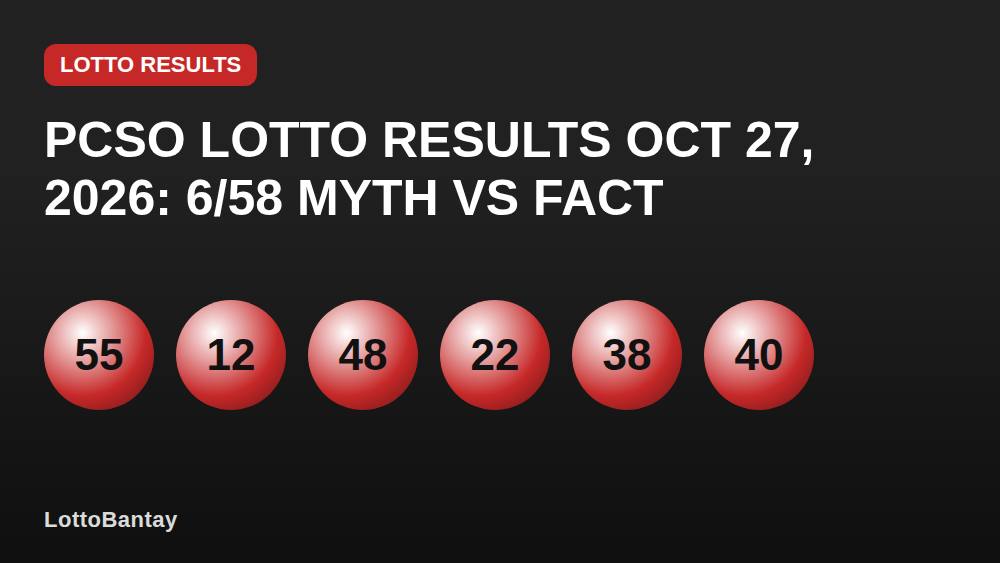
The October 27, 2026 Draws at a Glance
Three games went to the draw floor on Tuesday night, and one of them is now carrying a jackpot that has people lining up at outlet counters well before the 8:00 PM cut-off. The 6/58 Ultra Lotto rolled over again, pushing the top prize to P449,844,291.78 — a figure that puts this particular rollover among the larger 6/58 pots of the 2026 cycle.
The 6/42 Lotto drew a prize of P18,307,103.65, and the 6D Lotto 9:00 PM draw settled at P3,163,651.44. All three games produced no jackpot winner based on the official prize structure released for the evening, which is exactly why the 6/58 number keeps snowballing into the next draw.
The complete combination list — including the 6/58 winning line of 55-12-48-22-38-40, the 6/42 line of 17-18-13-41-30-24, and the 6D sequence 6-9-7-9-7-0 — sits in the table above. If you played any of these games, that table is your first stop before you do anything else. Verify your ticket against it line by line, not from memory, because memory is the single biggest cause of missed claims at PCSO prize counters.
One detail worth flagging for 6D players: the drawn sequence contains repeated digits — 9 appearing twice, 7 appearing twice. That pattern alone generates a wave of social media posts every time it happens, and most of those posts get the math wrong.
| Game | Winning combination | Jackpot (PHP) | Winners |
|---|---|---|---|
| 6/58 Ultra Lotto | 55-12-48-22-38-40 | 449,844,291.78 | |
| 6/42 Lotto | 17-18-13-41-30-24 | 18,307,103.65 | |
| 6D Lotto 9:00 PM | 6-9-7-9-7-0 | 3,163,651.44 |
Myth #1: Repeated Digits Mean the Machine Is 'Due' for a Fix
Every time a 6D result like 6-9-7-9-7-0 comes out, the same theory resurfaces: the machine must be malfunctioning, or the draw was manipulated because repeated digits 'look wrong.' It is the most persistent myth in Philippine lotto chatter and it collapses under the simplest scrutiny.
In a 6-digit game where each position runs 0 through 9 independently, the chance that no digit repeats across six positions is roughly 15.1 percent. Flip that around: there is about an 84.9 percent probability that at least one digit repeats in any given 6D draw. Repeated digits are not the anomaly. They are the overwhelming norm, and a clean six-unique-digit result is the rarer event.
Get this straight: a 6D result with repeated digits is not a red flag. It is the expected outcome almost six times out of seven.
The same logic applies to 6/58 and 6/42, where consecutive numbers in a combination — like the 17-18 pairing in Tuesday's 6/42 result — trigger identical accusations. In a 6/42 draw, the probability of at least one consecutive pair appearing is well above 40 percent. Seeing 17 and 18 land together is not evidence of anything except that combinatorics works the way it is supposed to.
What actually matters for players is the audit trail, and PCSO's is straightforward: draws are conducted under the Gaming and Amusement Board's oversight framework, with the draw machine and ball sets subject to inspection before each session. The results are published the same evening across PCSO's official channels. If you want to verify a result, verify it there — not from a screenshot forwarded eleven times.
Myth #2: Hot Numbers and Cold Numbers Predict the Next Draw
The hot-and-cold number charts are the bread and butter of every lotto tips page, including the ones that charge subscription fees. Here is the fact that the charts conveniently bury: each draw is an independent event. Balls do not remember the last draw, do not feel 'overdue,' and do not compensate for a dry spell.
Consider the 6/58 game. The odds of hitting the six-number jackpot on a single ticket are 1 in 40,475,358. That figure does not change whether you play 55-12-48-22-38-40 — Tuesday's actual winning line — or any other combination you can name. A number that appeared last week has exactly the same probability of appearing this week as one that has not shown up in two years.
Where the hot-and-cold framework does have real, measurable value is in number selection strategy for prize-sharing. This is the part that actually affects your expected payout, and it gets almost no attention. Because so many players cluster on birthdays (1–31), low numbers, and visually tidy patterns like 1-2-3-4-5-6 or multiples of 5, a win on those combinations is split among far more tickets. Choosing numbers above 31 or in the upper 40s to 50s does not improve your odds of winning. It improves your share if you do.
That is the honest version of the tip: you are not outsmarting the machine. You are choosing a less crowded lane on the same highway. For a P449 million jackpot, the difference between a solo claim and a ten-way split is the difference between a life-changing payout and a comfortable one.
What the 6/58 Rollover Actually Means for Ticket Buyers
A jackpot sitting at P449,844,291.78 draws in casual players who would otherwise skip the week, and that surge changes the economics of the game in ways worth understanding before you buy.
The 6/58 Ultra Lotto ticket costs P20 per play. On a normal draw with a modest pot, a single ticket's expected value is deeply negative — the house edge on PCSO's pari-mutuel games is substantial, and no jackpot size flips that. But as the pot grows, the expected value improves, because the prize pool grows faster than the number of possible combinations. At P449 million with a 1-in-40.4-million shot, the raw expected value on a P20 ticket is roughly P11 before accounting for the split risk, lower-tier prizes, and the 20 percent final tax on winnings above P10,000.
Add the split risk and the picture resets. When tens of thousands of extra tickets enter during a rollover week — and they do, typically a 40 to 60 percent bump in sales volume on a pot this size — the probability that any winning combination is shared rises sharply. The jackpot number on the board is not the jackpot you receive. After the 20 percent tax and any split, a P449 million headline can become a P180 million net payout, or a P45 million one with a four-way share.
None of this is a reason not to play. It is a reason to play with a fixed budget you set before you leave the house, not one you negotiate with yourself at the counter. P20, P40, P100 — decide the ceiling and treat it as entertainment spend, the same way you would treat a movie ticket.
How to Claim: The Deadline That Actually Bites
This is the section that costs people money, and it has nothing to do with number selection. PCSO gives winners one year from the date of the draw to claim their prize. After that, the prize is forfeited and returned to the charity fund. Every year, unclaimed prizes worth tens of millions of pesos expire because the ticket sat in a wallet, a drawer, or a car's glove compartment.
The claim process differs by prize size, and the thresholds are firm:
- Prizes up to P10,000: claimable at any authorized PCSO lotto outlet, or at the nearest PCSO branch. The 20 percent final tax does not apply below this threshold.
- Prizes above P10,000: claim at a PCSO branch office or the main office in Mandaluyong. Bring two valid government-issued IDs, the winning ticket, and a completed claim form. The 20 percent final tax is withheld at source.
- Jackpot-tier prizes: processed at the PCSO main office, with additional documentation and a verification period. Payout for eight-figure prizes is typically released via check within 10 to 15 banking days after complete documentation.
Two non-negotiables. First, sign the back of your ticket the moment you buy it — an unsigned ticket is a bearer instrument, and whoever presents it can claim it. Second, photograph both sides of the ticket and store the image somewhere you will actually find it. If the physical ticket is lost, the photograph does not replace it, but it gives you the date, outlet, and combination needed to file a formal report and establish your claim trail.
The 6/42 Lotto prize of P18,307,103.65 falls squarely in the main-office category, and anyone holding a winning line should be moving on it this week, not next month.
Reading the 6D Result Like a Regular, Not a Conspiracy Theorist
The 6D Lotto is the most misunderstood game on the PCSO roster, largely because its prize structure differs from the six-digit games players are used to. The 9:00 PM draw on October 27 produced 6-9-7-9-7-0 and a prize of P3,163,651.44.
What trips people up is the payout logic: 6D is a fixed-odds game, not pari-mutuel. You win by matching the digits in the exact positions drawn, and there are consolation tiers for matching fewer positions from the right. This is why the prize does not swell the way a 6/58 jackpot does — it is determined by the odds table, not by how many people played. A P3.16 million figure reflects a draw where the top tier was not hit and the prize carried according to the game's structure.
The practical tip here is positional. Because 6D requires exact position matching rather than any-order matching, players who treat it like a permutation game overthink their selections. There is no 'hot position' strategy that survives scrutiny. What does improve your experience is playing consistently with a small fixed stake — P10 or P20 per draw — rather than chasing the pot with escalating bets after a near-miss. Near-misses are designed to feel significant; they are not.
For players who prefer games with a slower, larger buildup, the 6/58 remains the flagship. For those who want a weekly rhythm with shorter odds and smaller pots, the 6/42 at P18.3 million is the middle ground.
The Only Number Strategy Worth Keeping
Strip away the charts, the dream books, the 'sure number' group chats, and the paid tipsters, and one strategy survives contact with the math: play consistently, play small, and play combinations that other people avoid.
That means a fixed weekly budget — P100 to P200 is a common and sensible ceiling for a casual player — spread across a small set of lines you actually chose rather than random Quick Picks you will not remember. Quick Picks are fine for convenience, but they eliminate the one advantage you control: avoiding the crowded birthday cluster of 1 to 31 that absorbs so much of the player base.
It also means tracking your tickets. A simple note on your phone with the date, game, combination, and outlet keeps you from re-buying the same line and lets you check results against the table above without digging through receipts. Players who claim prizes reliably are almost always players who know exactly what they bought.
The 6/58 Ultra Lotto will draw again soon with that P449 million figure on the line, and the queues will be longer than usual. Buy your ticket from an authorized outlet, sign it before it leaves the counter, and set your budget before you join the line. The draw is random. Your discipline does not have to be.