The P298.3 Million Draw That Killed Three Myths at Once
Friday night draws in the Philippines have a rhythm to them. By 9:00 PM, the queues at authorized lotto outlets in malls and barangay corners have thinned out, the bettors who remembered are already holding their tickets, and the rest of us are refreshing result pages while the PCSO draws the balls on live television.
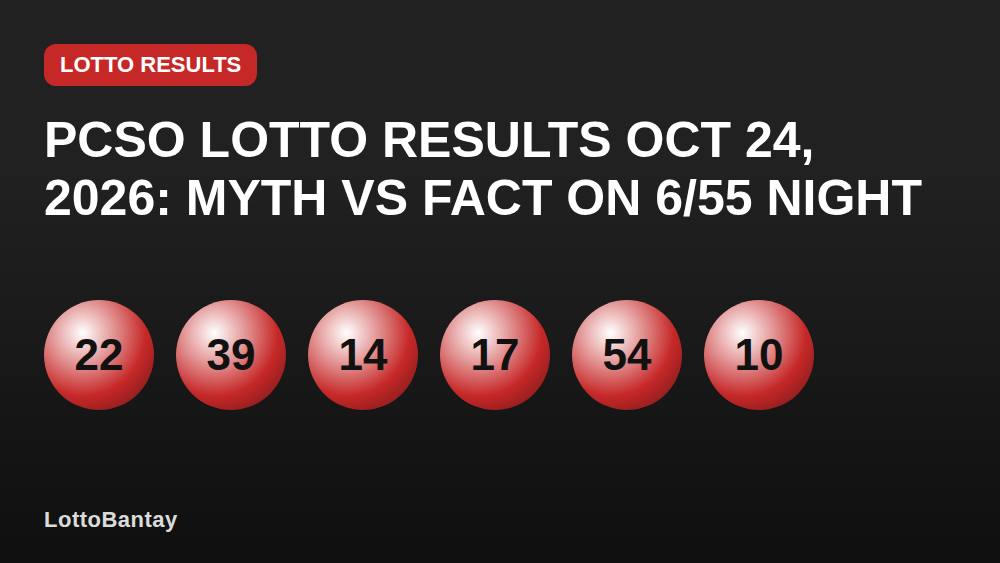
October 24, 2026 was one of those nights, and it produced a 6/55 Grand Lotto result that every regular player in the country will remember for a while: a jackpot of PHP 298,324,976.25 that carried over into the next draw because nobody matched the six-number combination drawn. The winning combo, for the record, ran 22-39-14-17-54-10 in the order drawn.
If you played the Grand Lotto that evening and walked away empty-handed, this article is not going to tell you to "play responsibly" and then send you on your way. What it will do is pull apart the stories that spread fastest in group chats after a big draw like this — the hot-number theory, the birthday-gap theory, the "the machine is due" theory — and line them up against what actually happened on the ticket. You will also find the full results for all three games that evening in the table above, including the 6/42 Lotto and the 6D Lotto, and we will reference those numbers rather than retyping them for the third time.
The short version: one draw night, three games, and enough data to settle a few arguments for good.
| Game | Winning combination | Jackpot (PHP) | Winners |
|---|---|---|---|
| 6/55 Grand Lotto | 22-39-14-17-54-10 | 298,324,976.25 | |
| 6/42 Lotto | 39-03-18-41-42-34 | 15,431,959.59 | |
| 6D Lotto 9:00 PM | 8-6-4-0-4-8 | 2,425,854.32 |
Myth #1: "Big Jackpots Are Drawn on Hot Numbers"
Here is the myth, stated as it usually appears in Facebook comments the morning after a rollover: the 6/55 machine is trending, the jackpot is nearly at PHP 300 million, so the balls that come out must be the ones that have been "hitting" in recent draws.
Now look at the actual combination: 22, 39, 14, 17, 54, and 10. That is not a cluster. 54 sits near the top of the 6/55 range, 17 and 14 sit in the low 20s, and 10 sits low. There is no obvious sequence, no string of consecutive numbers, no all-even or all-odd pattern. If you had built a ticket from the "hottest" numbers posted on any betting page last week, you would not have produced this set by accident.
This is the fact that the myth keeps avoiding: in a mechanical draw with 55 balls, every combination has exactly the same 1-in-28,989,675 chance. The PCSO does not weight balls by recent appearance. The machine does not know the jackpot is close to PHP 300 million. Each draw is independent of the last, and independence is not a technicality — it is the entire design.
Why the hot-number story feels true
Because our brains are pattern machines and the PCSO publishes enough history to feed them. If you pull the last 100 Grand Lotto draws, some numbers will appear five or six times and others two. That variance is expected. It is not a signal. A number that appeared in three of the last ten draws has the same probability of appearing tonight as a number that appeared in none of them.
Treat recent results as a record of what happened, never as a forecast of what will. That is the whole discipline, and it costs nothing to practice.
Myth #2: "Frequent Small Winners Prove a System"
There is a persistent belief that the players who keep hitting three or four numbers have cracked something — that they are reading the draw, adjusting their picks, and climbing toward the jackpot. Walk into any busy lotto outlet in Metro Manila and you will hear a version of this from the regulars holding a stack of past tickets.
The 6/42 Lotto result for October 24, 2026 gives the cleaner answer: the drawn combination was 39-03-18-41-42-34. Look at it. You have 41 and 42 adjacent, you have 39 sitting just below them, and 42 is the maximum ball in that game's range. A player chasing "safe middle numbers" would have missed three of the six outright. A player who chooses 42 simply because it is the highest number in the game is, by coincidence, one ball closer than the strategist.
The prize tiers in 6/42 work exactly as they should: matching three numbers pays a small fixed amount, matching four pays more, matching five pays substantially more, and matching all six takes the jackpot — which on this night was PHP 15,431,959.59, again with no winner. Small wins happen because thousands of tickets are sold, not because the winners possess a system. The math is blunt about it: if you buy more tickets, you have more chances, and more chances means more three-number hits. That is the entire mechanism.
The concrete difference between a system player and a volume player shows up in the wallet. A system player buys the same six numbers for a year and blames bad luck. A volume player — the one who joins an office pool — buys more combinations per draw and understands that each extra ticket is a tiny, honest increase in coverage. Neither one can beat the odds, but one of them is not lying to himself.
Myth #3: "The Machine Owes You After a Rollover"
The gambler's fallacy dresses well in the Philippines. After a jackpot rolls over twice, the phrase "sure na 'yan this week" starts circulating, as if the probability of a winner rises because there was no winner last time.
It does not. The 6D Lotto 9:00 PM result on October 24 is the perfect counter-example because of its format. The drawn digits were 8-6-4-0-4-8 — six digits, order matters, and the jackpot was PHP 2,425,854.32. Notice the repeated 4 and the repeated 8. In a six-digit game with order mattering, there are one million possible outcomes, and a pattern with repetition is just as likely as one with six distinct digits. Nobody looks at 8-6-4-0-4-8 and calls it a system. They should treat 6/55 and 6/42 the same way.
What a rollover actually does is change the size of the prize on offer, not the chance of winning it. A PHP 298.3 million jackpot is a bigger number than a PHP 20 million one. The ticket you buy is identical. The balls are identical. The odds are identical. The only thing that changed is how much a win would be worth — which is a reason to be clear-headed about your budget, not a reason to believe the machine is warming up.
The rollover maths in peso terms
- At PHP 20 per 6/55 play, a PHP 500 budget buys 25 combinations out of 28,989,675. That is 0.000086% coverage. It is real, it is honest, and it is not a strategy.
- Joining a 10-person office pool multiplies your coverage by ten for the same personal outlay, but splits any prize ten ways. A PHP 298 million jackpot shared eight ways is still life-changing; shared ten ways, still life-changing.
- Chasing a rollover with money you need for bills converts a cheap entertainment into a bad loan. The jackpot does not care either way.
What the October 24, 2026 Results Actually Show
The table above carries the full picture: the three games, the combinations in drawn order, the jackpot figures, and the winners column. Read it as a snapshot of one evening, not a trend line.
Three games, three rollovers. The 6/55 Grand Lotto at PHP 298,324,976.25, the 6/42 Lotto at PHP 15,431,959.59, and the 6D Lotto at PHP 2,425,854.32 all went unclaimed. Nights like that happen — they are the quiet majority — and they are exactly why the myth industry thrives. A rollover feels like unfinished business, and unfinished business feels like an invitation.
But there is a useful, unglamorous fact buried in that results table: the PCSO publishes every draw, every day, in order, with the jackpot and the winner count. That transparency is the resource serious players use. Not to predict, but to budget. If you know the jackpot carried over, you know the prize is larger; you also know that your chance did not move. Both pieces of information belong in the same decision.
One more thing worth stating plainly: the draws are conducted live and the results are public. There is no insider feed, no leaked combination, no text message from a "PCSO employee" who can sell you the winning numbers. Every year, people lose money to that scam. The legitimate result is the one you can read on the PCSO's own channels and in summaries like this one.
How to Read a Lotto Results Table Like a Bettor, Not a Believer
Most players glance at the combination, check their ticket, and close the page. That is fine. But if you want to get more out of a results page than a yes-or-no answer, here is the routine worth building.
- Confirm the date and game name first. A 6/55 result is not a 6/42 result, and a Saturday draw is not a Friday draw. Misreading the date is the single most common source of "I won!" followed by disappointment.
- Check the drawn order against your ticket carefully. In 6/55 and 6/42, order does not matter for winning — but on your ticket, the printed sequence is what you compare against. Read slowly. A 10 mistaken for a 01 is a real error people make.
- Note the jackpot and the winners column. A rollover tells you the next draw is worth more. A winner count above zero tells you the prize was split. Both are information; neither is a prediction.
- Log your spend. Keep a simple note of how much you played and when. Players who track spending are the ones who stay in the game for years without it becoming a problem.
That is the whole system. No charts, no hot-number dashboards, no paid "sure hit" groups. The results page is a ledger, and reading it as a ledger is the only edge available.
The Responsible-Play Facts Nobody Puts in the Myth Post
Myth posts are always exciting. Facts are usually boring, and this section is the boring one — but it is the part that keeps players in the game long enough to actually enjoy it.
In the Philippines, lotto play is restricted to adults 18 and over, and PCSO outlets are required to refuse minors. Play is priced per combination, typically PHP 20 for the 6-ball games and PHP 10 for 6D, which means a night's entertainment can cost less than a fast-food meal or more than a week's groceries depending on how you play. The choice is yours, and it should be a choice — made before you leave the house, not at the counter.
Practical limits that work
- Set a monthly lotto budget in pesos and treat it as spent the moment it leaves your wallet. Do not top it up after a loss.
- Never play with money earmarked for rent, tuition, medicine, or debt payments. The jackpot is a long shot, not a plan.
- If you find yourself checking results compulsively or chasing losses, step back for a month. The draws will still be there.
- Keep tickets in one place and photograph them. Lost tickets cannot be claimed, and the PCSO requires the physical ticket for validation.
Prize claiming has its own facts worth knowing: small prizes can be claimed at authorized outlets, larger prizes at PCSO branches, and the biggest jackpots require processing at the main office with valid identification. Bring the ticket, bring ID, and expect the process to take time. There is no shortcut and no fee to a "facilitator."
What the Next Draw Looks Like — and What It Doesn't
The next 6/55 Grand Lotto draw will carry the unclaimed PHP 298,324,976.25 forward, plus whatever the new draw adds. That is the headline, and it is a genuinely large one. The 6/42 Lotto and 6D Lotto will also roll over their respective jackpots from the October 24 results.
What the next draw does not look like: a machine that is "due," a combination that is "overdue," or a set of numbers with a better chance than any other. The 6/55 range still holds 55 balls, the combination still has 28,989,675 possible arrangements, and your ticket still has one of them.
If you play, play with clear eyes. Pick numbers you like — birthdays, anniversaries, random quick picks — because the emotional value of a number is real even if its statistical value is not. Buy what your budget allows. Check the results the next morning with your coffee, and if the table above says nobody won, that is not a sign. It is just a Friday.
The players who last are the ones who treat lotto as what it is: a small, regulated, occasionally thrilling expense. The ones who get hurt are the ones who treat a rollover as a debt the universe owes them. Same ticket, same odds — very different outcomes.